Afternoon Tea with Al Qaida’s Spiritual Godfather
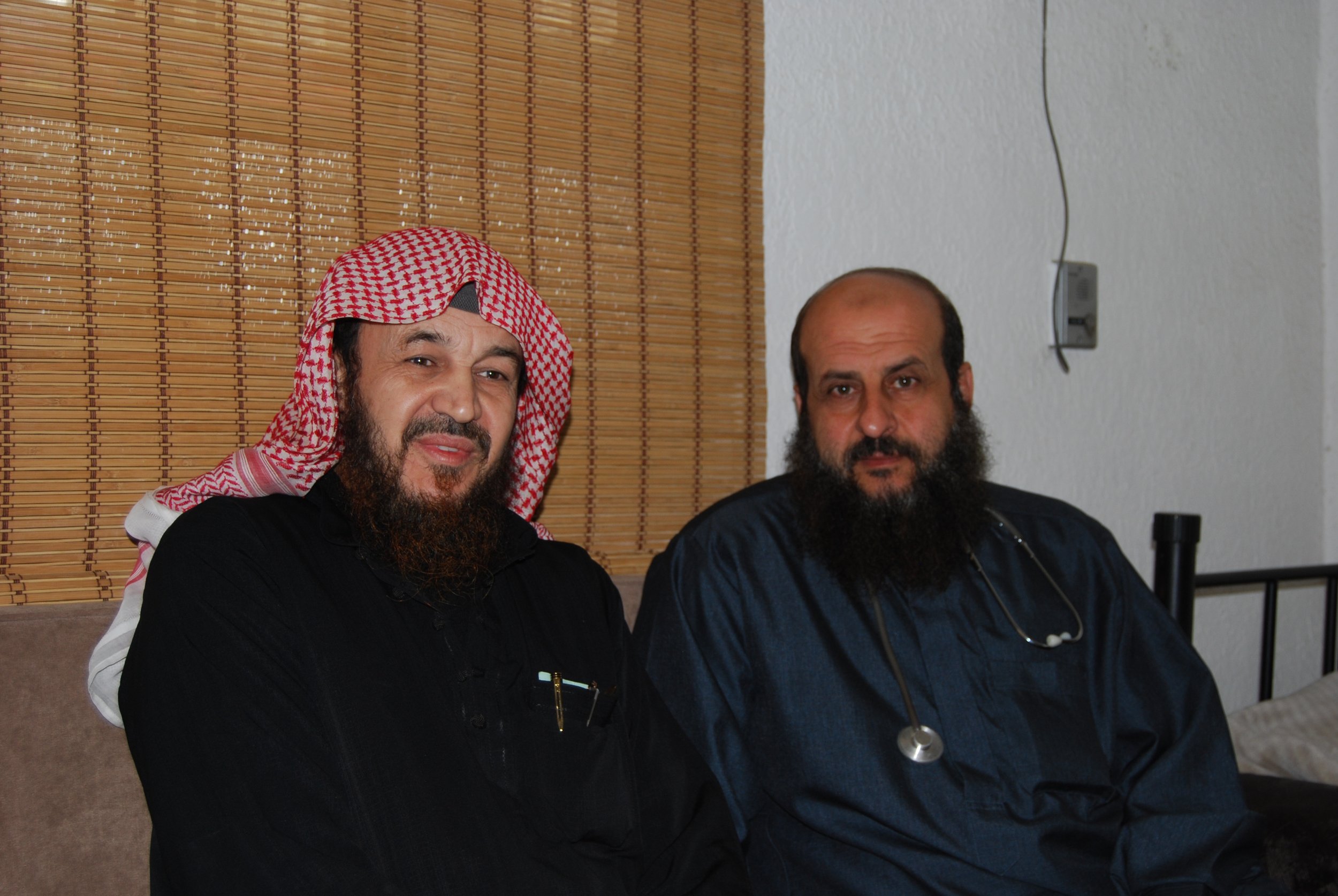
Al-Maqdisi and Dr. Fathi Samara at Samara’s clinic, Zarqa, Jordan March 2015. Photo credit: Muna Fadhil.
Few outside the world of militant Salafi Islam have heard of Abu Mohammad al-Maqdisi. Those who know him will tell you he was part of al-Qaida’s upper echelon during the era of Osama bin Laden, a close associate of al-Qaida’s emir in Afghanistan, Ayman al-Zawahiri, and a mentor to al-Qaida’s founder in Iraq, Abu Mus'ab al-Zarqawi. West Point once described him as “the most influential scholar in the world of militant Islam.”
I had developed an interest in jihadi Salafi Islam while covering the religion beat as a journalism student at Goldsmiths, University of London, in 2014–2015, with the rise of Daish and the then-Twitter wars between Daish and al-Qaida. So when I was visiting family in Jordan, the idea of an afternoon tea chat with al-Qaida’s spiritual godfather—al-Maqdisi, who was living in Zarqa west of Amman the capital—felt intriguing.
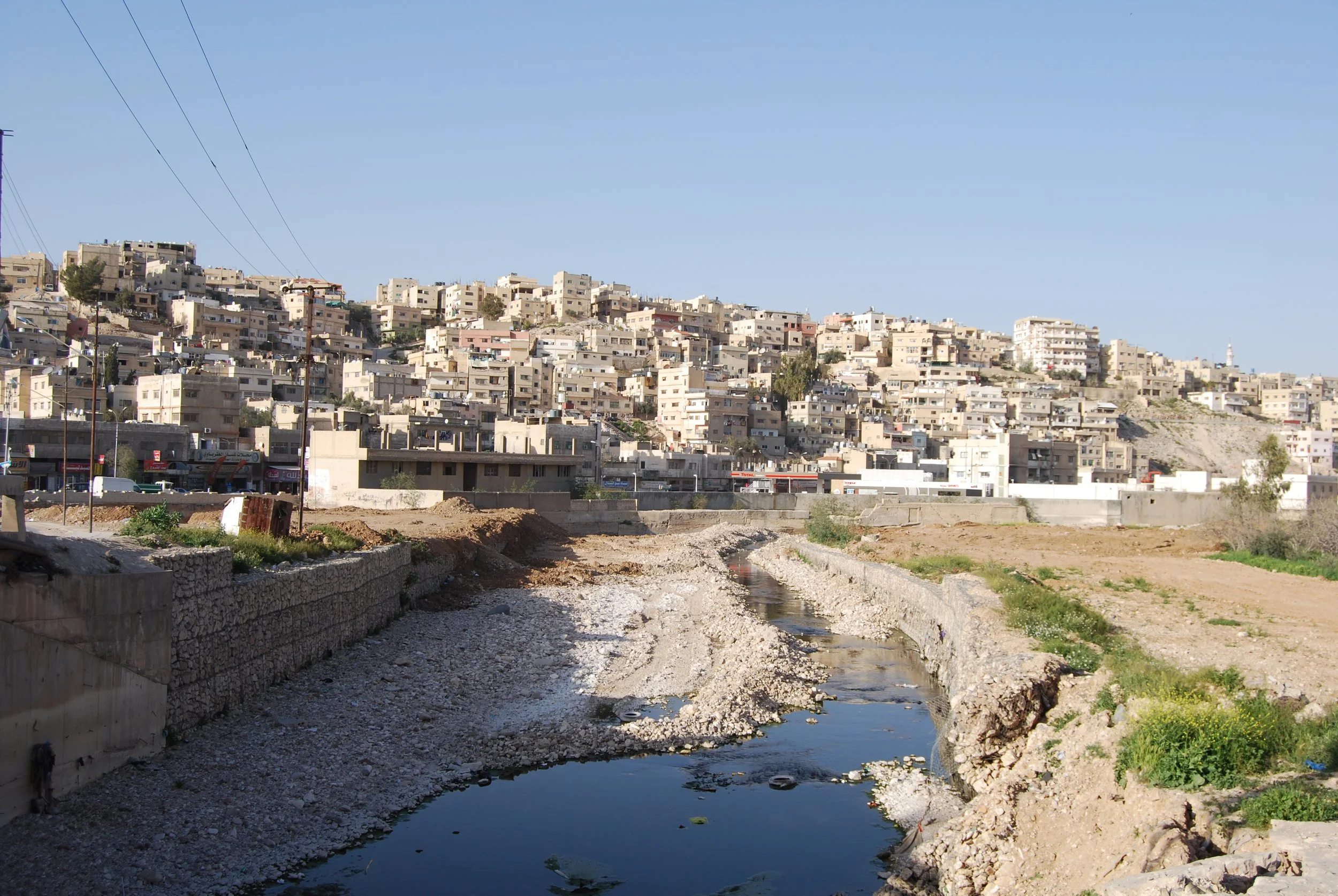
Zarqa skyline. March 2015. Photo credit: Muna Fadhil.
I didn’t exactly seek him out; the interview was suggested to me. I hesitated for a few minutes. Al-Maqdisi was also a close associate of Abu Qatada, another senior al-Qaida figure who, at the time, had just been extradited from Britain on terrorism charges in a high-profile case that dominated headlines. I worried about getting into trouble once I returned to the UK—like being stripped of my student visa. But when al-Maqdisi shuffled into the room, I gulped and began the interview.
Al-Maqdisi stroked his beard and leaned back slightly to ease the back pain caused by years of prison confinement. With one eye on me and one on the CCTV screens across from him, he gestured to indicate that the interview had begun.
To his left was a bed; to his right were beige couches. There were intercom buzzers on both ends of the room and a filing cabinet full of religious and medical books. Two women took turns serving cups of tea. One seemed bemused by the sight of me struggling to keep my headscarf from slipping; the other glared with suspicion and hatred.
We were at the clinic of Fathi Samara, a physician, refugee from Jenin, Palestine, and the man who introduced me to al-Maqdisi. Samara was a fellow al-Qaida sympathizer. Samara, like al-Maqdisi, was engaged in an at-the-time social media campaign against the Islamic State, or Daish, which they felt tarnished the reputation of global jihadi Islam with their wild antics and breaking away from al-Qaida—and why they agreed to be interviewed.
Soft-spoken, friendly, and charismatic, al-Maqdisi almost made me forget that I was in the presence of al-Qaida, a violent global terrorist group. The interview started with chitchat about back pain remedies—al-Maqdisi suffers chronic back pain from spending extended periods in prison, a total of 14 years during the last two decades, at that point.
Then al-Maqdisi dove in to defend his recently tarnished reputation among jihadi circles stirred by Daish.
Al-Maqdisi’s controversy among jihadi circles began to surface for his role negotiating with Daish for the release of British and American aid workers in Syria Peter Kassig and Alan Henning, whom Daish accused of espionage, and later Jordanian pilot Muadh al-Kasasbeh, whom Daish accused of bombing its territory as part of the Jordanian Armed Forces.
All three attempts failed when Henning and Kassig were beheaded in October and November 2014, and al-Kasasbeh was burned to death in January 2015.
But the real damage to al-Maqdisi’s credibility came in February 2015, a month after al-Kasasbeh’s death, when Daish released recordings of al-Maqdisi negotiating with them to release the later slain pilot. This, Daish cited, was incriminating evidence that the global jihadi preacher al-Maqdisi was betraying the cause by siding with an enemy of the global jihadi movement—in this instance the Jordanian government—and calling into question al-Maqdisi’s legitimacy as a jihadi spiritual leader.
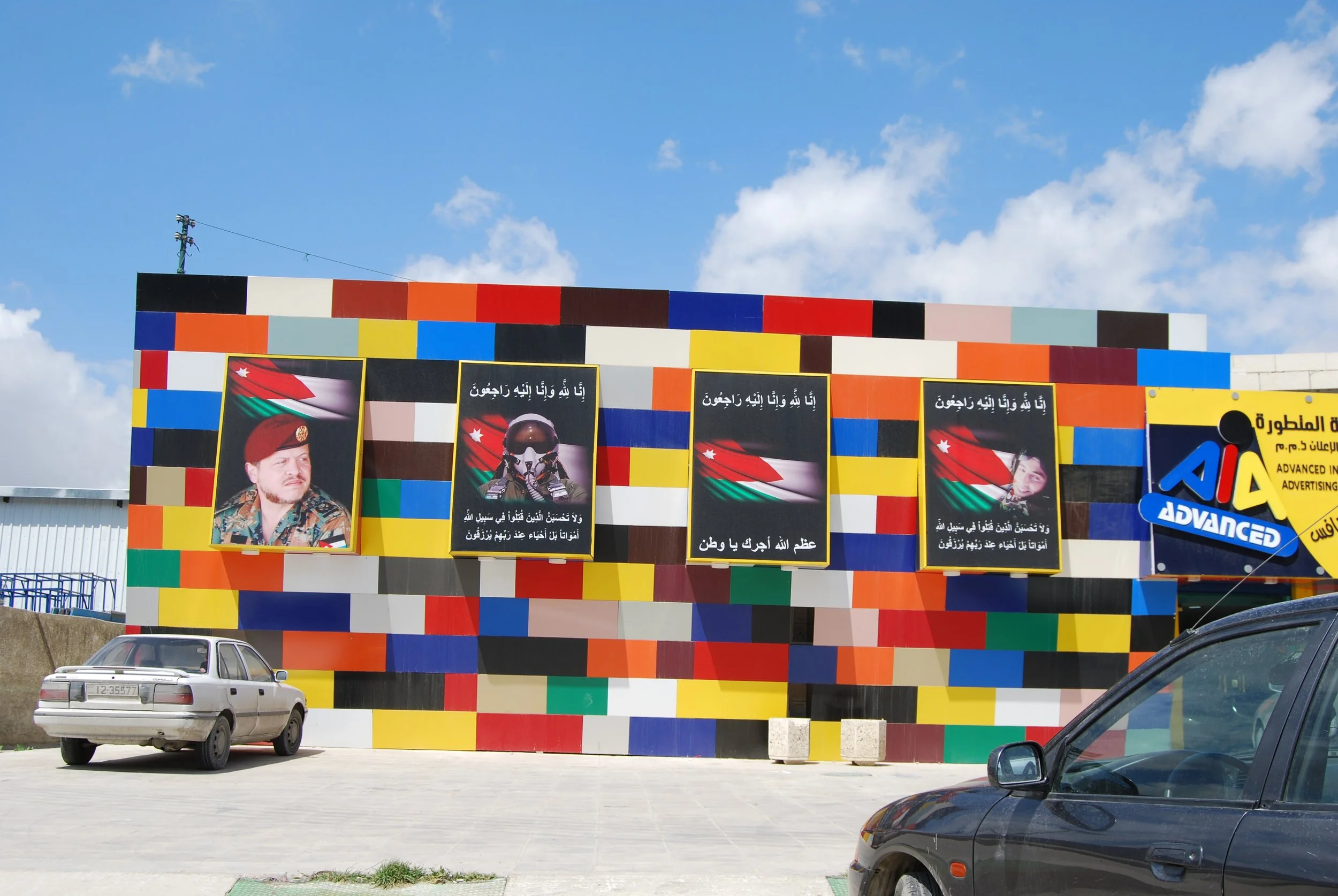
Mural of King Abdullah of Jordan and pilot al-Kasasbeh outside car wash on Zarqa Autostrad highway. March 2015. Photo credit: Muna Fadhil.
I asked al-Maqdisi what motivated him to negotiate with Daish for the release of the captured pilot al-Kasasbeh, and al-Maqdisi acknowledged on the record that he agreed to do so in exchange for his freedom, something Jordanian officials publicly denied.
Al-Maqdisi cited his old age and frail health after decades in prison, and that he was negotiating the release of the pilot in exchange for the release of al-Qaida detainees in Jordan, one of whom was an Iraqi female suicide bomber who survived a botched attempt to detonate her explosive vest. She was executed after Daish burned the pilot to death.
To add further to the controversy, al-Maqdisi and Abu Qatada appeared on mainstream television stations, including Jordan’s Roya channel, where al-Maqdisi appeared as a guest days after his release in February 2015 to speak about his role in negotiating hostage releases and to criticize Daish. For jihadi groups, mainstream television is widely viewed as a source of moral debauchery, with watching such channels considered sinful—making these appearances deeply provocative in militant circles.
These televised interviews were not incidental. They were part of a coordinated effort by al-Maqdisi and Abu Qatada to form a front representing al-Qaida’s interests in Jordan and to counter Daish. The initiative was known as al-Zarqawi’un al-Judud—the “New Zarqawis”—a reference to al-Maqdisi’s former disciple, Abu Mus'ab al-Zarqawi, the al-Qaida leader in Iraq killed by a U.S. drone strike in 2006.
Al-Maqdisi defended his television appearances as a necessary evil. Daish, he argued, had broken away from al-Qaida’s control and was doing lasting damage to jihadi ideology. He said it was imperative to make clear that al-Qaida should not be held responsible for Daish’s actions, and that the only legitimate jihadi actor in the region was the al-Nusra Front in Syria—one he described as being “closer to al-Qaida’s ideology than the Islamic State.”
I asked al-Maqdisi why he thought Daish had gained such appeal over al-Qaida, despite many prominent jihadi spiritual leaders like himself turning against them.
Al-Maqdisi said Daish’s appeal lay in its declaration of an actual “Islamic Caliphate”—a functioning state—something al-Qaida had long aspired to but failed to achieve. The location of this so-called state made it even more compelling. “In the old days we fought in battlefields much further away,” he said. “My brothers and I went to Afghanistan. Some of us went to the Philippines and Somalia. Why would jihadi Salafis not fight today when the battle has moved this close to Israel? Just the thought of a jihadi war being in this critical geographic location attracts many jihadi Salafis.”
At the same time, al-Maqdisi stressed that his criticism of Daish was not ideological in principle. “My criticism of the Islamic State is not a criticism of what they stand for,” he said. “We understand jihad cannot be carried out in a complex situation like the Levant, with its many factions and Arab and international espionage agencies, without making mistakes. But there are mistakes we cannot forgive” referring to Daish’s excessive violence including against other jihadi groups which Daish saw as competition.
This, al-Maqdisi argued, explained why the Jordanian government had turned a blind eye to al-Qaida’s activities inside the country. He said authorities allowed both him and Abu Qatada to speak freely so long as their messaging targeted Daish—a sign, in his view, that Jordan and the wider international community were recalibrating their stance toward al-Qaida as a lesser evil.
“The Islamic State shows up slaughtering those who disagree with them, including fellow Muslims,” al-Maqdisi said. “Killing on camera, abusing, burning, pillaging, and doing things the international community had not seen before, like enslaving and kidnapping Yazidi women. This made them [the international community] see al-Qaida and jihadi Salafi Islam—and I am considered one of their terrorist preachers—as a side they can cooperate and communicate with, whether they like it or not.”
“The Islamic State shows up slaughtering those who disagree with them, including fellow Muslims, killing on camera, abusing, burning, pillaging, and doing things the international community had not seen before, like enslaving and kidnapping Yazidi women. This made them see al-Qaida and jihadi Salafi Islam—and I am considered one of their terrorist preachers—as a side they can cooperate and communicate with, whether they like it or not.”
Al-Maqdisi found this apparent attitude shift of the Jordanian government amusing rather than incriminating. During his interview on Roya TV, he openly thanked and saluted al-Qaida members in Algeria, Yemen, and Syria for their efforts in negotiating with Daish—remarks the channel chose to broadcast. “When did this ever happen on Jordanian television before?” he mused.
A year after I interviewed al-Maqdisi, Jordan began cracking down on what it saw as ‘problematic’ Islam, marking a turning point. It began with security forces raiding the offices of the Muslim Brotherhood in 2016 and culminated in dissolving and outlawing it completely in 2020, in addition to other counterterrorism laws and measures Jordan began to enforce heavily. The space that had once allowed figures like al-Maqdisi and Abu Qatada to operate with relative tolerance narrowed rapidly as the state reasserted control over Islamist movements of all stripes.
I eventually lost touch with the jihadi cleric. Still, every so often he resurfaces on X, formerly known as Twitter—usually shortly before his account is suspended again. He continues to argue with Daish over who better represents jihadi Islam, but his attention has increasingly shifted elsewhere.
In recent posts, al-Maqdisi has turned his toward Syria’s current president, Ahmed al-Sharaa, and his cabinet. Once the founder of al-Qaida’s former offshoot and ally, the al-Nusra Front, al-Sharaa formally renounced al-Qaida in 2016. Since then, al-Sharaa has gone mainstream, appearing in a suit and tie in meetings with European and U.S. officials to discuss border security and economic reform. For al-Maqdisi, this transformation represents yet another betrayal of the global jihadi cause.
It is clear that al-Qaida has lost ground to Daish. Yet I find myself sharing al-Maqdisi’s fears about Daish, with their more glossy yet equally violent propaganda and its more digitally savvy approach that is far more advanced than al-Qaida’s grainy videos of preachers bobbing their heads and waving fingers as they hurl verbal threats against the world. I would be curious to sip more cups of tea with him and pick his brain about the jihadi landscape today.